Showing posts with label Canadian Politics. Show all posts

Saturday, 30 June 2018

We Shouldn't have to Fact Check Everything Our Representatives Say; Yet We Do

As adults, in a democratic society, we have rights and freedoms.  Something that we are beginning to hear more about is responsibility.  Last week, a number of people took to twitter to give some specialized attention Calgary Nose Hill MP Michelle Rempel's tweet thread defending her right to cater to an audience.   What she apparently found upsetting was an article regarding the introduction of independent "fact checkers" to verify information being shared on Facebook Canada.

"Freedom of speech" has been a topic that is receiving increasing speculation.  In Canada's Charter of Rights and Freedoms it states: 
"The Canadian Charter of Rights and Freedoms guarantees the rights and freedoms set out in it subject only to such reasonable limits prescribed by law as can be demonstrably justified in a free and democratic society.

Everyone has the following fundamental freedoms:
(a) freedom of conscience and religion; (b) freedom of thought, belief, opinion and expression, including the freedom of the press and other media of communication; (c) freedom of peaceful assembly; and (d) freedom of association."

The caveat is detailed within the first paragraph; "subject only to such reasonable limits prescribed by law as can be demonstrably justified in a free and democratic society".   Rempel's argument is based on the assumption that the media is biased against conservative thought/speech/beliefs.  "Bias" though, suggests a reluctance to take into account another's point of view rather than refusing to regurgitate actual lies.

Take, for instance, the federal Conservative Party's claim that "Justin Trudeau is charging Canadians over $90,000 to upgrade his summer home".  That sounds a lot different than "$90,000 worth of upgrades to be completed on 60 year-old parliamentary residence".   The latter is true.  The former is sort of true, it's just missing valuable information such as; the alternate residence, or "summer home" is an official residence, and is currently the main residence used to host official business as 24 Sussex, also an official residence, is under renovation.  The latter, however, wouldn't make people as angry.


A recent Pew Research project asked over 5,000 Americans to classify 10 statements as either fact or opinion.  The results revealed that Americans who self-identified as having "high political awareness" correctly identified factual statements 36% of the time.  The same group was able to identify opinion statements 44% of the time.  People who self-identified as having "low political awareness" were able to correctly identify factual statements 17% of the time and opinion statements 29%.  If you think back to exams, what does it mean to receive "44%" (or less)?  Fail.

There is something very wrong if the class average is a fail.  The problem is that if people cannot distinguish between personal opinion and fact, there needs to be more accountability upon those who are sending out the information.    For those who want an everyday example, look to the Calgary and Edmonton SUN; directly under the names of columnists Rick Bell and Lorne Gunter you can see, written in bold, the word OPINION.  This is accountability.   Readers who have followed this blog will note that I began to include a similar disclaimer in recent posts.

Research is a skill.  When my son was ignoring assignments in grade 7, the teacher and I had a conversation.  As it turned out, the only assignments he was behind on were those that required internet research.  I asked if they had taught the kids how to perform research on the internet.  If the average inquiry in Google provides 649,000 results, how is he supposed to determine what information he should be using and including?  I received this education in university because I graduated in 2013 when internet research was expected.  Had I completed my degree the first time, in 2002, I might not have learned that.

People have been sounding the alarm since Trump showed up in American politics.  A man who has zero regard for the truth, and even bragged about lying to Trudeau in their first meeting about trade, has one of the largest platforms in the world.  Some journalists, and others, have taken to blaming Trump's "fake news" rhetoric for the recent mass shooting in a newspaper office.   Alexandre Bissonette, the young man who killed six people in a Quebec Mosque, said he had to do something after Trudeau tweeted a welcoming message to potential immigrants and refugees because he didn't want immigrants to "kill (his) parents".  Why would he think newcomers to Canada would do that? 

Because opinion media like infowars and rebel media push a particular narrative to make money.
While people have the right to believe whatever they want and express opinions regarding those beliefs, certain individuals, groups and businesses, especially those who are purported to be "trustworthy" based on their position of authority or platform need to have accountability.  And we, as consumers of information, should be able to demand the truth.  We deserve it.

Deirdre Mitchell-MacLean
Content Director/Writer
countersigncanada.ca
NOTICE: This article contains both fact and opinion.  Links to supporting documentation within article.

As of June 30, I have moved to a website http://countersigncanada.ca/blog/
I should have mentioned that earlier. My apologies.

Saturday, 23 June 2018

Conservatives Are Taking Alberta's Votes for Granted

On Thursday we learned an extension of the current equalization formula was passed on June 6, 2018.  Why were we surprised to learn this?  Because none of the Conservatives who voted against the amendment mentioned it even though they (mostly) showed up to vote on it.   No, we learned this from the media three weeks after the fact.

Since the final vote on June 6, the silence has been deafening. There are 53 CPC "defenders of the West", including its leader, Andrew Scheer (SK).  There is also a guy in Alberta whose heart and mind is hardly a moment away from the House of Commons, the Leader of Alberta's Official Opposition, Jason Kenney.  And none of these representatives, not one of these "unfair equalization" proponents was passing around the gasoline for the West to light its hair on fire?  Get real.

Part of that would of course be due to the fact that there was a federal by-election going on in Quebec that saw the Conservative Party of Canada win a seat on June 18.  While campaigning in Quebec, a political party does not need half of its caucus making waves against the province.

La Presse Canadienne / Jacques Boissinot
The only hiccup for the Conservatives was back in May when Manitoba MP Ted Falk let his social conservatism fly in the House of Commons when he yelled out "abortion is not a right!" in response to the Prime Minister.  Quebecers are, apparently, more liberal-minded than the Western CPC MPs and Conservative MPs from Quebec were forced to distance themselves from the comment. Ain't unity grand?

And speaking of unity, the only CPC MP who appears to be maintaining the purported conservative values is Maxime Bernier, who was removed from the front bench by Andrew Scheer earlier this month.  The CPC is on a mission: Elect a provincial Conservative Party in Quebec in October.  All MPs must toe the party line.

To do that, Andrew Scheer must continue to be the champion of all things Quebec; from supply management to equalization (no link available because; silence).  Jason Kenney, who likely wanted to be on as many stages as possible in Quebec during the summer, will have to stand up for Alberta as the lone voice for Alberta Conservative values of "it's mine, damn you, all mine!"

Andrew Scheer will have to continue to be the voice for Quebec, at least until October 2, 2018, but they won't worry too much about the Conservative support out West; Kenney has plenty of gasoline for all of those who can be set off by incomplete and misleading remarks about equalization. And while your hair is on fire, don't forget to donate to the CPC; they need your support to campaign for Quebec's interests.


Deirdre Mitchell-MacLean
Content Director/Writer


NOTICE: This article is a mixture of both opinion and fact. Links within the article.

Monday, 18 June 2018

Coming of Age: Trinity Western and Canadian Law

Trinity Western University is a private institution in Langley, B.C. that provides a "whole person, Christ-centred approach to education".   Their mission statement clearly defines their goals as both a learning institution and the role they expect their students to fulfill in society:
"As an arm of the Church, to develop godly Christian leaders: positive, goal-oriented university graduates with thoroughly Christian minds; growing disciples of Jesus Christ who glorify God through fulfilling the Great Commission, serving God and people in the various marketplaces of life." 
 A prospective student to Trinity Western must be willing to sign a "Community Covenant" through which the student agrees to adhere to a code of conduct befitting the University's Christian standards.  This covenant includes a specific item that students will voluntarily abstain from "sexual intimacy that violates the sacredness of marriage between a man and woman".

The Civil Marriage Act (Bill C-38) received Royal Assent in Canada on July 20, 2005.  The Act formally acknowledged the rights of same-sex couples to marry in Canada.  This has been the law of the country for almost 13 years.

The issue with the Covenant is not the first of the aforementioned statement; one is specifically targeted at a group of individuals and the other would apply to all students equally.  The first item, regarding sexual intimacy, can be equally applied to both same sex and heterosexual intimacy outside of a marriage bond.  As this applies equally to all students, it is non-discriminatory and well within the rights of the school to request it of its students.

The second part defines "marriage (as) between a man and woman" which contradicts the Civil Marriage Act (2005) under Canadian law.  The expectation is that if a prospective gay, but legally married, student wishes to attend the University, they will abstain from marital relations.   It was the discriminatory factor regarding marriage which first raised an issue for Canadian law societies.

Two law societies initially denied accreditation; the Law Society of Upper Canada in Ontario, and the Nova Scotia Barrister's Society. The Law Society of B.C. eventually joined them after first agreeing to grant accreditation.  Trinity Western took the cases to court in all three provinces.

The Provincial Court of Nova Scotia ruled in favour of Trinity Western and the Nova Scotia Barrister's Society did not appeal the decision. The Ontario Court of Appeal ruled in favour of the Law Society of Upper Canada (Ontario). The Court of Appeal in B.C. ruled in Trinity Western's favour.  Trinity appealed the ruling in Ontario and the LSBC appealed the ruling in B.C. which brought the case to the Supreme Court of Canada (SCC).

Photo: schuettlaw.com
On Friday, the SCC delivered their ruling on the case, 7-2 in favour of the law societies.

I was lucky (?) enough to be involved in a discussion spanning three days (and counting) with three people who disagree with the SCC's decision.  To me, the entire issue boiled down to legal ethics.  Signing the Community Covenant, which makes a claim that is incompatible with the law (the current one in Canada, not the biblical one) showed either a disdain for the laws in Canada or a complete willingness to disregard them.  Neither option is a promising beginning for a future lawyer.

Another argument, and one that was brought forward by legal experts as well, is that religious freedom was under attack (I searched and have yet to find a code of conduct in any Canadian school which forbids students from practicing the religion of their choice, in private, on their own time).  In the case of Trinity Western though, it would appear they have a particular vendetta against gay people.

Back in 2001, Trinity Western applied for an education program to train teachers.  The British Columbia College of Teachers (BCCT) denied it based upon their Covenant of the time which specifically stated a list of "Practices that are biblically condemned" such as "sexual sins including... homosexual behaviour".  The SCC ruled, 8-1, that Trinity Western, as a private school, was within its rights to have this covenant but if these views were brought to a teaching environment, the BCCT would then have the authority to act.  That was before the Civil Marriage Act (2005) however.

In response to the issues facing students of Trinity Western, a petition has been created by a group called ONE TWO asking the University to "make our community a more loving, accepting and safe place for all students".  The University said that it "may consider the wording" within its covenant but has, for now, placed its plans for a law program on hold.  Some religious institutions are discovering that they must change with the times in order to remain relevant with a dwindling membership. For the three people who I've been arguing with for days, only one thing comes to mind:
"Adapt or perish; now as ever, is nature's inexorable imperative". ~H.G. Wells
Canadian Christians, as a majority, no longer support stoning, polygamy, or taxes, so I think it may be time to give up the homophobia as well.
Deirdre Mitchell-MacLean
Content Director/Writer

Sunday, 10 June 2018

Environment and the Economy; Majority Rules or Working Together?

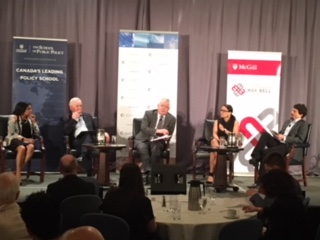
I attended the Bridging Divides: In Search of Sound Public Policies for Energy and Environment in Canada panel discussions last week.  The program was a collaboration between Canada's Ecofiscal Commission, McGill University's Max Bell School of Public Policy and the University of Calgary's School of Public Policy.  While there were no shortage of economists present, oil and gas industry representatives, First Nations, environmentalists, and a few former politicians rounded out the guest panelists.

David Dodge, an economist and former Governor of the Bank of Canada, was the first to speak.  The environment and the economy, he said, is "an issue that concerns city, province and country.  It's an emotional issue" he added, referencing the "complexity" of these discussions Chris Ragan, Chair of the Ecofiscal Commission, had mentioned.  "Science tells us we must reduce emissions in the future.  Activists believe it needs to be done without regard for the economy.  The other extreme denies any need to reduce emissions; the bulk of Canadians are in the middle".   Jean Charest, former Premier of Quebec, said it was about "aligning good policy with public opinion.  How do you bring people to the table in a polarized debate?  Too many people aren't listening".

"We don't want a tragedy of the commons but it must be dealt with today" Dodge continued "it is undefined but certain. How do we reduce the cost of reduction or increase the perceived benefit of reduction?"  While a sustainable environment in 200 years will be of little benefit to those of us alive today, reducing energy use isn't without its perks.  Steve Williams, CEO of Suncor, talked about how the company has reduced its production energy use by over 50% from what it was 15 years ago and their "plan is to reduce it by another 30% by 2030" because it saves them money.

L-R; Jen Winter, Ed Whittingham, Chris Ragan,
Steve Williams, Jean Charest

Williams stood beside Premier Notley as she introduced the carbon tax legislation back in 2015.  He was also a member of the Climate Change Advisory Panel.  While the public had not seen direct carbon taxes, the oil industry, as a large emitter, has been priced since 2007.  "Production," Williams said "accounts for 20% of the carbon footprint.  The other 80% is consumption".  Stephen Cornish, in a conversation afterwards, said that was equivalent to passing the buck.

Dodge introduced what he sees as the two most important questions in the debate.  What is the incentive and how do we pay for it?  "The cost is not zero" he said, "it costs to change".  "Carbon tax, cap and trade, greater efficiency equals lower costs and it's better than regulations".  Jen Winter of the Calgary School of Public Policy agreed, "there's a reduced administrative burden on government" to use pricing instead of regulation.  However, Dodge, Winter, Charest and Ed Whittingham admitted regulations may need to accompany pricing.

Whittingham noted "carbon pricing isn't the be-all-end-all".  Poor communication in the rolling out of carbon tax policy allowed the policy to open proponents "up to 'it's just a cost, it's not going to do anything'".  Charest agreed adding the public has "experience with perversion of (government spending). The government says money will be used for this but then put it into general revenues.  And that's good for government, to give them flexibility "but it erodes the public's trust.  "We are the biggest consumers of energy, produce the most garbage" he said, but putting a price on that behaviour "is a challenge".

Complementary policy, said Whittingham, is something like a clean fuel policy which ignites innovation.  Even environmental stewards don't want to shut down an economy.  Winter mentioned the reluctance of some people to make the change because the cost was too low.  This is in line with what many have said as well about meeting our targets from the Paris Accord; the cost would have to be almost $200/tonne.  "Start low" said Winter, to provide the incentive for people to make a gradual change.

Williams also examined the effect Canada can have on the rest of the world.  "China is starting to reinvest in coal" he said "because (they) can't trust Canada to deliver the oil.  That doesn't help anyone if one of the world's largest populations goes back to coal".  Even though Canada does not have the whole solution he said, people see Canada trying.  "It's about leadership," offered Charest, "the world expects it of us".

L-R: Carissima Mathen, Preston Manning,
Pierre-Gerlier Forest, Carol Anne Hilton, Stephen Cornish
"I find it scary" said Williams "and I find the current politics of it (being a believer or non-believer) is complete nonsense and (voters) shouldn't allow that framing of the debate".  He also said he hopes some politicians "get brave enough" to have the conversations and take different positions.

Preston Manning added that in a polarized debate the solution should lie in "the reconciliation of conflicting interests by non-coercive means".  He felt all major interests needed to be identified and invited to the table.  Stephen Cornish, CEO of the David Suzuki Foundation also said that not only should everyone be present but the goal needed to be identified.  "Politics are driving people away from the table.  We haven't even agreed where we need to go" but the continued division is making it seem less likely we will be able to get there.

There are differing interests however as we've seen with the carbon tax implementation.  While the easiest thing for the federal government would have been to implement a 'one-size fits all' approach, they really wanted the provinces to find what would work for them said Winters.  This isn't always easier though, as Williams pointed out.  A company that operates across provincial borders now has to ensure it is adhering to a number of different policies when it could have been just one. 

Pierre-Gerlier Forest, Director and Palmer Chair at the University of Calgary School of Public Policy, asked how it was possible to find a cohesive policy nationally.  "There is an anti-pipeline party running for government in Quebec" he said with slight exasperation, "how do we have a national discussion when everyone has a different point of view?"  Dodge had addressed this somewhat as well noting that people are no longer willing to allow someone to make decisions for them; they want to be involved in decision-making after the election as well.

Admittedly, it is a small number of people who engage in the entire political sphere.  There are special interest groups for everything today.  Are you particularly impressed by the need for social housing?  There's an advocacy group for that.  Do you feel the environment is the greatest priority today?  There's an advocacy group for that.  Do you support Canadian oil development?  There's an advocacy group for that.

"The federation is even more diverse" added Carissima Mathan, Vice Dean and Associate Professor of Law from the University of Ottawa. "It's more about geography; a reconciliation of interests away from a fundamental moral question versus immediate economic survival".  Carol Anne Hilton, CEO and Founder of the Indigenomics Institute, said there was "an alarming tendency to rely on 'national interest'" as a way to reduce collaboration.  Cornish stated there was "dissonance in policy; a fundamental disagreement on what we're trying to achieve".  It's hard to disagree with him.

At the end of the panel discussions, we were no closer to finding a solution to the current problem of how the environment and economy can, and must, work together.  However, both compromise and communication are necessary to move forward.  As Preston Manning said "the majority should respect the minority because one day, you might be the minority".
Deirdre Mitchell-MacLean
Content Director/Writer

Monday, 3 July 2017

The Politics of Party Affiliation

In the last week there has been a lot to talk about on the political front and very little of it provided optimism for Alberta.  In BC, MLA Christy Clark, who approved the Kinder Morgan pipeline expansion, lost her bid to form government and the NDP's MLA John Horgan was named Premier designate on June 30, 2017.  Though an NDP government in BC would seem like a good thing for an NDP government in Alberta, there has been a difference of opinion between the two over the necessity of increasing pipeline capacity to the BC coast.

If that wasn't enough to begin to rile the Conservative troops in Alberta as they prepared to celebrate Canada's 150th birthday, Prime Minister Justin Trudeau delivered his Canada Day speech in Ottawa naming the individual provinces and territories that make up this incredible country we call Canada and somehow skipped over Alberta.  Trudeau and politically engaged individuals across the country felt the backlash before it even started.  Just remember, when conservatives make a gaffe and apologize, everyone is expected to accept the apology and move on (*Note, there were a number from Fildebrandt so I just chose one at random).

Credit: Jason Kenney's official Facebook page
In Alberta, the conservative party "leaders" (Jason Kenney and MLA Brian Jean) and shakers (MLA Derek Fildebrandt) pounced on the opportunity to rally support from the separatists and conspiracy theorists.  Alberta Liberal Leader, David Khan, responded to MLA Brian Jean saying "Canada Day is the ONE day a year when politicians should be inclusive..." (no pun intended, I'm sure).  Neither the Alberta Party Leader, MLA Greg Clark, nor Alberta Premier Rachel Notley made any mention of the omission on social media.

I once had a conversation with someone about how it was beneficial for provincial parties to have federal counterparts.  The NDP, Liberals and former PC's all had a federal likeness of the same name and the Wildrose had Reform.  Even once the latter two parties merged federally, both provincial parties can lay claim to the parentage when it suits them. While the same could also be said for the NDP and Liberals, in a province that went very blue in the federal election the provincial parties are having a rough time with their federal namesakes and even their provincial cousins.

If David Khan didn't have enough of an uphill battle in the province before (and he did), the Prime Minister has managed to be unhelpful despite additional funding provided to the province during the downturn, expedition of infrastructure funding and pipeline approval. For the Alberta NDP, the federal party delivered a stunning blow almost one year after the provincial party was elected to government by tabling, and approving further discussion of the "Leap Manifesto" for implementation into federal NDP climate policy.  More recently, MP Jagmeet Singh, a federal NDP leadership candidate, claimed he would not support the addition of any pipelines, east or west for Alberta oil. Meanwhile, the federal Conservatives elected MP Andrew Scheer, a social conservative, to lead their party into the future of yesteryear. Personally, I'm starting to think it a blessing to not have a federal counterpart at all.


Friday, 24 February 2017

M103, Canada

M103 doesn't seem like it would have any relation to Alberta politics.  It's a federal motion and the Alberta government isn't involved.  The opposition parties haven't said anything (but people are baiting them on Twitter).  The problem I've seen is how many people are complaining about a federal motion that does not attack their freedom of speech is an attack on their freedom of speech.  That part is confusing. M103 is not.

Back in June of 2016, Samer Majzoub from Pierrefonds, Quebec started a petition that was sponsored by his MP, Frank Baylis.  His petition was simple; asking the government to "join us in recognizing that extremist individuals do not represent the religion of Islam, and in condemning all forms of Islamophobia."  The petition received almost 70,000 signatures.  The highest numbers (over 3,000) came from Ontario with 43,573, Quebec with 12,308 and Alberta with 7,760.  The government responded in December stating "(t)he Government of Canada condemns all forms of racism and discrimination, including Islamophobia".

The official text is below:
That, in the opinion of the House, the government should: 
(a) recognize the need to quell the increasing public climate of hate and fear; 
(b) condemn Islamophobia and all forms of systemic racism and religious discrimination and take note of House of Commons’ petition e-411 and the issues raised by it; and 
(c) request that the Standing Committee on Canadian Heritage undertake a study on how the government could
         (i) develop a whole-of-government approach to reducing or eliminating systemic racism and religious discrimination including Islamophobia, in Canada, while ensuring a community-centered focus with a holistic response through evidence-based policy-making, 
         (ii) collect data to contextualize hate crime reports and to conduct needs assessments for impacted communities, and that the Committee should present its findings and recommendations to the House no later than 240 calendar days from the adoption of this motion, provided that in its report, the Committee should make recommendations that the government may use to better reflect the enshrined rights and freedoms in the Constitution Acts, including the Canadian Charter of Rights and Freedoms.

To me, this seems like a reasonable request as the government has supported a motion and issued statements in the past on anti-Semitism... twice... or three times (and I only went through Google's first page). For comparison, the text of the anti-Semitism motion is below:

That, in the opinion of the House:
a) there has been, in the words of the Joint Statement issued following the meeting of the United Nations General Assembly  on January 22, 2015, “an alarming increase in Antisemitism worldwide,” including the firebombing of synagogues and community centres, the vandalizing of Jewish memorials and cemeteries, incendiary calls for the destruction of Israel and the Jewish people, and anti-Jewish terror;
b) this global anti-Semitism constitutes not only a threat to Jews but an assault on our shared democratic values and our common humanity;
Therefore the House:
a) declares its categorical condemnation of anti-Semitism;
b) reaffirms the importance of the Ottawa Protocol on Combating anti-Semitism as a model for domestic and international implementation;
c) reaffirms, in the words of the Ottawa Protocol, that, “Criticism of Israel is not antisemitic, and saying so is wrong. But singling Israel out for selective condemnation and opprobrium – let alone denying its right to exist or seeking its destruction – is discriminatory and hateful, and not saying so is dishonest;”
And the House further calls upon the government to:
a) continue advancing the combating of anti-Semitism as a domestic and international priority;
b) expand engagement with civil society, community groups, educators, and other levels of government to combat anti-Semitism and to promote respect, tolerance, and mutual understanding
 I just want to point out that there were no calls for Anti-Semitism to be defined.  In fact Irwin Cotler, the MP who brought the anti-Semitism motion forward in 2015, has suggested that "Islamophobia" be changed to "anti-Muslim bigotry" because it is "a misunderstood word".  To me, that makes it even more important that this motion should go through and perhaps the public could be educated to understand that "Islamophobia" is akin to "Anti-Semitism".

D.